
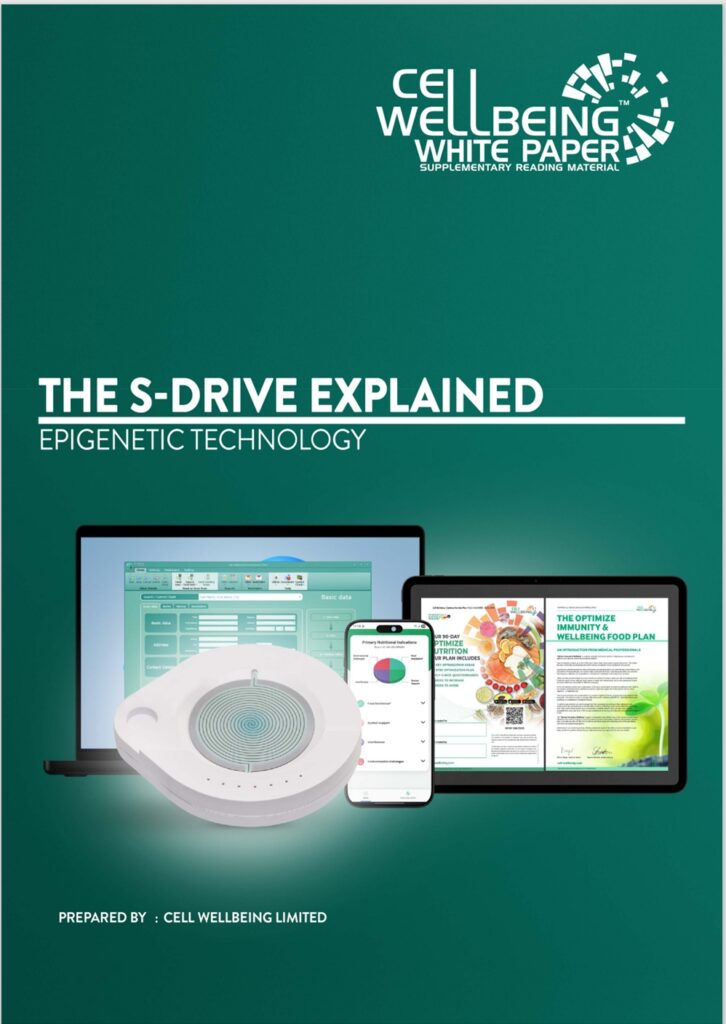
S-Drive is a new wellness technology that connects operators directly with our Information Center in
Germany. The portable device is attached via a USB connection to a PC Or laptop and once connected to
the Internet, is ready to go.
The device employs a powerful software that allows for the gathering Of digital information from an
individual’s hair and bulb samples. Once digitized, the data pack is encrypted and
sent via the Internet for evaluation in Germany.
The returned results are converted into a PDF report and then returned to the S-Drive Provider’s inbox in
less than 15 minutes. The report provides a wealth of information encompassing over 800 personalized
markers.
EPIGENETIC INFORMATION
Evaluation of epigenetic information is an innovative technique that has unlimited potential in assisting
determined individuals how to make positive changes in their well-being and performance. Epigenetic and
homeostasis information includes the dynamic intensities Of wave emissions from a living body with
octillions of atoms, trillions of cells and thousands of cellular interactions every second in each day.
Environmental irritants are reflected in this cascade Of information. A simple analogy to understand this
process could be the act of throwing a stone into a pond of water, thus causing a series of ripples that
radiate outwards. These ripples contain much more information about the potential impact on the
environment than the information that we would obtain simply by observing the stone. The ripples are in
continuous motion and interaction, as well as adapting to any other waves in the pond before hitting the
shoreline.
In a similar way, Cell-Wellbeing’s evaluation technology allows its S-Drive operators to understand the
interaction of the countless environmental impacts on the metabolic system.
The recent revolution in scientific discoveries has brought about this new approach to Epigenetics as it
provides underlying information of the entire system.
The information from the hair and bulbs that was recently extracted and immediately evaluated isparticularly valuable for those who are interested in creating a preventive strategy based on nutritional
factors and lifestyle.
This type of information is readily obtained when four freshly plucked strands of hair bulbs are placed on
the coil at the center Of the S-Drive. In many cases, the information contains deep rooted information that
could be stressing the system, sometimes even before an expression of symptoms. The hair, with its
corresponding roots, must be extracted from the occipital part of the skull.
Nutritional and dietary information is highlighted in the returned report in various forms. Environmental
irritants are also highlighted as are foods which are consuming more energies than they can provide. These
foods should be avoided for 90 days, which allows the body to recover its equilibrium.
The digitally captured information contained within the hair shaft and roots highlights the In-Vivo (inside the
body) epigenetic landscape map, identifying the best route to achieve optimal wellbeing. This knowledge
allows operators to consider recommendations and preventive measures.
The information from the hair shafts and roots quickly fade away after being separated from the body.
Consequently, it is essential to digitize the roots and the strands in less than three minutes after being
extracted from the occipital part Of the skull.
A German scientist named Herbert Frohlich predicted that cells
must emit electrical informational waves that are used by a living
body to communicate with each other. He was one of the first to
propose the existence of certain collective vibrations which
collaborate with each other and carry out the instructions of DNA
and cellular proteins.
He came to predict that certain frequencies now called: Frohlich
Frequencies, detected just below the cell membranes could be
generated by vibrations in these proteins. NASA has also used this
technique to carry information of astronauts back to earth.
THE INFORMATION
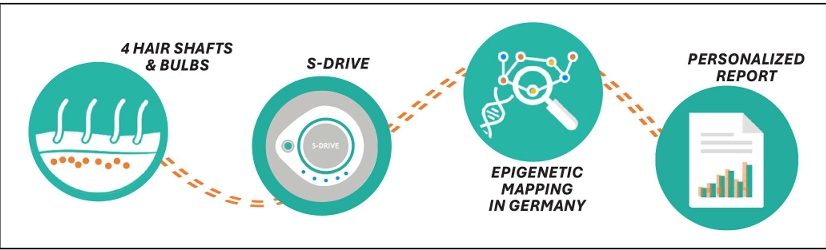
Simplified Work Flow From Hair Test to Report
The digitized information from the hair bulbs is received, decoded and run through logarithms and Al
systems in our Evaluation Center in Germany. The generated information also highlights certain
environmental influences which are then evaluated separately and compared with coherence points, a
process duringwhich a powerful algorithmic program classifies the resulting data.
The resulting information is then run through the Al programs which link the relevancy Of certain
environmental influences. Some stand Out as being more relevant than others.
Although the results may not be expressed in the form Of current symptoms, they may provide information
Of a potential underlying stressor. This may be due to the affects Of weak cells that have not yet been
incubated or manifested.
The evaluation program classifies the intensities before using the data to generate associated relevancy
pages within the 30+ page report. Immunity and wellbeing are important ingredients for everyone.
Epigenetic Mapping has become increasingly more important to many health & wellness centers and
professional sports coaches as it provides operators with a client’s personalized environmental and
nutritional information.
The comprehensive report also suggests a 90-day food plan in order to optimize a client’s immune
response and overall well-being. This report information is available in Non-Vegan and Vegan options.
Underlying food sensitivities impact many individuals. Unlike known allergies, food sensitivities absorb our
cellular energies as we unwittingly fight off the food sensitivity impacts. In addition, food sensitivities can
present a clue as to oncoming allergies such as gluten! The report also identifies the top food sensitivities
so the client can avoid these foods prior to them becoming a challenge in the body.
ENVIRONMENTAL REPORTS
Each report is a record of the individual environmental and nutritional influences that could be challenging
a person’s physiology. These epigenetic stressors are digitized and processed for people in 67 different
countries.
The 9 categories are evaluated and classified according to their relevancy within the group. The resulting
information and scores are presented in various pages in graph form which are also linked to separate
pages on the Gut, Circulatory or Immune systems. Items are classified as “priority”, “advisory” or
“consider” which reflects the order of priority relevance.
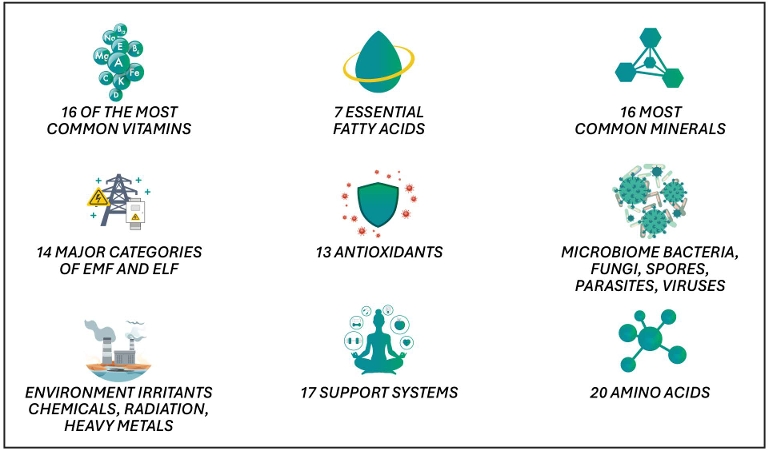
The Reports covers these Categories and Elements
80% of functionality stressors commence in the gut which is why the report specifically highlights
influences on this area. Of equal value are the report pages addressing the clients’ potential Immunity
stressors from environmental impacts such as toxins and Electro Sensitivity.
In addition, the reports also highlight your clients underlying food sensitivities, Other than their known
allergies. Removing these sensitive foods from the diet often provides positive results within 48 hours. The
bodies cellular system often requires 90 days to assimilate the changes to diet and lifestyle. It is therefore
important to follow a nutritional protocol program and avoid certain foods before obtaining an updated report.
Our environment controls up to 98% of the way in which many of our genes express themselves. This
means the way in which they act physically and control virtually all aspects Of our metabolism and life.
Currently, almost everyone on the planet is operating below their potential due to the affects of the
environment. Processed foods, low nutrient intake, toxins and chemicals, electromagnetic fields and
extremely low frequency influences are among the key influences scientists believe are responsible for a
breakdown in the body’s normal day to day functions.
Most Of us would like to know which food or environmental irritant has the highest degree Of stress on our
epigenetic system. A report, every 90 days, provides the necessary information to recommend to clients.
Helping to create the optimal nutritional spectrum for each person will allow their genes to be positively
expressed, thus potentially correcting cellular imbalances and weaknesses.
The reports cannot be considered a physical diagnosis, cure or treatment; the information indicates areas
that may require a higher level of attention, as well as suggesting to the clinician other tests and
examinations.
In addition, if other conventional treatments do not provide relief or other pathologies do not seem to fit
with the symptoms or the history Of a patient, the broader area Of epigenetic information may add further
useful considerations. This is particularly true when the Gut or other environmental irritants are considered
as the cellular body can hide certain toxins or microbiological impacts, providing false or negative results
in conventional tests.
For healthcare professionals, the reports are a quick and effective way to obtain an overview of underlying
irritants along with a roadmap of areas to pursue to correct those challenges that are impacting the health
and well being Of their client.
WHY DO WE RECOMMEND REPEATING YOUR EPIGENETIC TEST EVERY 90 DAYS?
When you complete an epigenetic wellbeing assessment at Global Health Clinics, one of our key recommendations is to follow your personalised programme for approximately 90 days and then consider repeating your assessment.
Why 90 days?
Because biology takes time.
Your body is constantly renewing itself. Different cells and tissues regenerate at very different rates, from just a few days in the gastrointestinal lining to around four months for a red blood cell. A 90-day period therefore gives you a meaningful window in which to make changes to your nutrition, lifestyle and daily habits—and then review how your body’s priorities may have shifted.
90 DAYS GIVES YOUR BODY TIME TO RESPOND
An epigenetic assessment is not a diagnosis. It is designed to provide information about environmental, nutritional and lifestyle factors that may be relevant to your current wellbeing.
The value comes not simply from doing the assessment, but from acting on the information.
Over the following 90 days, your personalised programme may encourage changes to your food choices, nutritional intake, hydration, sleep, stress management, exercise and other lifestyle factors.
As these changes are consistently applied, your body’s requirements can change too. That is why repeating the assessment can provide a useful opportunity to review your progress and develop the next stage of your wellbeing plan.
THE GUT: CHANGES CAN BEGIN SURPRISINGLY QUICKLY
The gastrointestinal tract is one of the fastest-renewing areas of the human body.
Cells lining the intestine are continually being replaced, with much of the intestinal epithelium turning over approximately every 3–5 days.
This rapid renewal is one reason nutritional and lifestyle changes can sometimes be noticed relatively early.
The gut also has an extremely important relationship with the immune system. Rather than simply being a tube through which food passes, the intestinal lining is a highly active interface between our food, microbiome, immune cells and the rest of the body.
When your initial epigenetic programme identifies foods or environmental factors that may be worth reducing while increasing supportive nutrients, the first weeks of your plan can therefore be particularly important.
Some clients tell us they begin noticing differences in digestion, comfort, energy or general wellbeing relatively quickly, although everybody responds differently.
BLOOD: A LONGER BIOLOGICAL CYCLE
Other changes require more patience.
A healthy red blood cell has an average lifespan of approximately 120 days.
Throughout its life it circulates around the body, transporting oxygen to tissues and helping carry carbon dioxide back towards the lungs.
This longer biological cycle helps illustrate why we encourage clients to think in terms of months rather than days when making meaningful nutritional and lifestyle changes.
Your body needs time to digest nutrients, absorb them, metabolise them and distribute the necessary building blocks throughout your tissues.
Ninety days gives us a much more meaningful point at which to ask:
What has changed—and what does your body appear to need now?
SKIN: RENEWAL YOU MAY EVENTUALLY SEE
Your skin is the body’s largest organ and is continually regenerating.
Research estimates that the epidermis can renew approximately every 28–56 days, although turnover varies with factors including age and health.
Deeper structural processes, including collagen production and remodelling, can take considerably longer.
This is another reason consistency matters.
The benefits of improved nutrition, hydration, sleep and lifestyle aren’t always immediately visible. The body needs sufficient raw materials—and sufficient time—to undertake repair, maintenance and renewal.
YOUR BODY NEEDS THE RIGHT BUILDING BLOCKS
Human health is extraordinarily interconnected.
The nutrients contained in our food first need to be properly digested and absorbed. They then need to be metabolised and circulated before they can be used by cells throughout the body.
Protein, essential fats, vitamins, minerals and other nutrients provide building blocks for processes associated with:
- energy production
- tissue maintenance and repair
- immune function
- nervous-system function
- hormone production
- neurotransmitter production
- healthy blood formation.
This is why we prefer a targeted plan rather than simply taking more supplements.
More is not necessarily better.
The goal is to identify priorities and give the body appropriate nutritional and lifestyle support, then reassess rather than continuing indefinitely with exactly the same programme.
YOUR MIND AND LIFESTYLE MATTER TOO
Wellbeing isn’t created by nutrition alone.
Sleep, movement, relationships, emotional wellbeing, workload, stress and your general environment can all influence how you feel and function.
Over 90 days, small daily changes can become meaningful habits.
A personalised wellbeing programme may therefore include not only food and nutritional recommendations but also practical changes designed to support relaxation, recovery, resilience and overall quality of life.
Our aim is to help you create a programme you can actually live with—not an unrealistic list of restrictions.
WHY REPEAT THE EPIGENETIC ASSESSMENT?
Think of your first assessment as a snapshot in time.
It identifies priorities based on the information being assessed at that particular point.
After approximately 90 days of following your programme, repeating the assessment provides another snapshot.
We can then compare the two and ask:
Which priorities have reduced?
Which areas still appear important?
Have new priorities emerged?
What should we continue, change or remove from your programme?
Instead of guessing what to do next, your follow-up gives us an opportunity to build a new plan around where you are now.
Don’t Let Your First 90 Days Be the End of the Journey
If you completed your epigenetic assessment around three months ago, this is a good time to review how you have been feeling.
Look back at where you started.
Has your energy changed?
How is your digestion?
How are you sleeping?
Have your food habits changed?
Are you managing stress differently?
Which recommendations were easiest to follow—and which were difficult?
Even subtle changes are worth discussing.
Your 90-day follow-up isn’t about receiving a pass or fail. It is about learning from the last three months and making your next programme more targeted, practical and personalised.
READY FOR YOUR 90-DAY REVIEW?
If it has been approximately three months since your last epigenetic assessment, contact Global Health Clinics in Takapuna, Auckland to arrange your follow-up.
Bring your previous results with you and we can review your progress, repeat your assessment and help you develop your next personalised 90-day wellbeing plan.
Three months can change a lot. Your next assessment can help you decide what comes next.
Contact Global Health Clinics to book your 90-Day Epigenetic Follow-Up Assessment.